The Elder Scrolls 6 has spent so long in hiding that, by 2026, it might as well be officially classified as a cryptid. Bethesda’s next big fantasy RPG still lurks in the shadows, occasionally poking its head out with a teaser before vanishing like a Khajiit in the night. Fans have moved beyond simple excitement and into a sort of feral, snack-fueled vigilance. Let’s be real: after Skyrim dominated entire console generations, the pressure on its sequel is heavier than a dragon’s hoard.
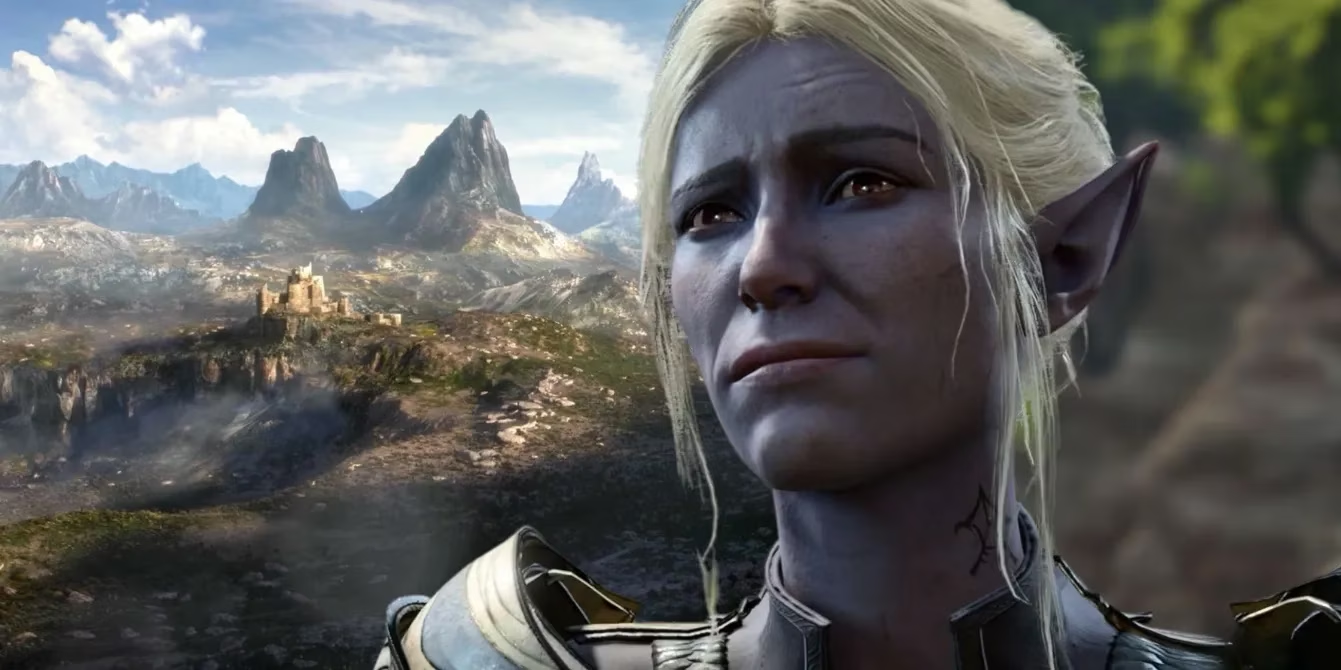
Baldur’s Gate 3, meanwhile, strutted back into the room like it owned the place, dice bag jingling. Larian Studios’ hit embraced old-school Dungeons & Dragons crunch: ability scores, skill checks, saving throws, and more numbers than a tax form. It worked. The game became a phenomenon. But according to former Bethesda lead designer Bruce Nesmith, The Elder Scrolls 6 probably will not follow that same stat-obsessed road. In a recent interview, he said, “I think that through Skyrim, Bethesda has wanted to have the game get out of its own way.” Long story short: Bethesda has been trimming the math homework for years, and it is unlikely to stop now.
That does not mean The Elder Scrolls 6 is doomed to be shallow. It just means the character sheet may stay in the drawer while the story does the heavy lifting. And that is where Baldur’s Gate 3 can still serve as a brilliant teacher.
What Baldur’s Gate 3 Actually Proved
Many players fell for Baldur’s Gate 3 not because they loved toggling proficiency bonuses, but because Astarion had emotional damage and Karlach wanted a hug. The proof is in the pudding: crunchy stats are optional seasoning; compelling companions are the main course. The Elder Scrolls 6 could skip the spreadsheet and still borrow the real magic—characters who grow, make terrible choices, and occasionally break a player’s heart.
Skyrim succeeded by streamlining the experience, but its narrative and characters received a much more mixed reception. Some followers felt about as lively as a mannequin with a sword, and many quests were memorable more for their locations than their emotional weight. After Starfield’s divisive reception, Bethesda has very little room to fumble the next chapter.
| Game | Character System | Story & Companion Punch | Audience Vibe |
|---|---|---|---|
| Skyrim | Streamlined, nimble | Mixed; lots of freedom but flat followers | Legendary despite grumbles |
| Baldur's Gate 3 | Crunchy, D&D-style | Rich, messy, memorable | Adored, award-hoarding |
| The Elder Scrolls 6 (likely) | Streamlined | Needs to step up | Desperately awaited, nervously optimistic |
The table tells the tale. Nobody is asking Bethesda to turn The Elder Scrolls 6 into an accounting simulator. They are asking for a world where people actually feel like people.
Where Hammerfell Fits In
Rumors still circulate that The Elder Scrolls 6 will unfold in Hammerfell, land of curved swords, fierce Redguard politics, and probably too much sand. Nothing official has surfaced, but if Bethesda chooses that setting, there is plenty of room for nuanced factions and morally sticky questlines. A good world can carry a game, but only if the people inside it feel like more than quest vending machines.
A Hammerfell setting could lean into political tension, ancient grudges, and sword-singer mysticism. That is a strong foundation—but only if the characters standing on it have personalities beyond handing out fetch quests and muttering the same three lines for fifty hours.
The Starfield Wake-Up Call
Starfield and Baldur’s Gate 3 launched about a month apart. One became a cultural lightning bolt with awards falling into its lap, while the other inspired a thousand think pieces about being wide as an ocean but deep as a puddle. That is not the legacy The Elder Scrolls 6 wants to inherit.
The lesson is less about stats and more about consequence. Baldur’s Gate 3 made players feel that their choices could absolutely wreck something, and that was thrilling. The Elder Scrolls 6 does not need detailed character sheets to succeed. It needs companions who remember things, consequences that sting, and stories that do not just wait politely for the player to show up.
By 2026, all Bethesda has to do is remember that RPG stands for role-playing, not roll-spamming. If The Elder Scrolls 6 pairs Skyrim’s inviting simplicity with Baldur’s Gate 3’s talent for messy, human storytelling, the wait might actually be worth it. Until then, the cryptid keeps hiding.