In the grand tapestry of video game history, few threads have shimmered as brightly in recent years as the one woven by Larian Studios' Baldur's Gate 3. A faithful yet transformative homage to the world of Dungeons & Dragons, its success is a testament to the alchemical process of adaptation—knowing what to preserve from the sacred texts of tabletop tradition and what to transmute for a new digital age. Among its many innovations, one element emerges not as a mere feature, but as a living, breathing philosophy of combat: the environment. It is a silent, omnipresent actor on the stage of battle, a character in its own right whose potential, fully realized by Larian, stands as a luminous beacon for the future of the very game that inspired it.
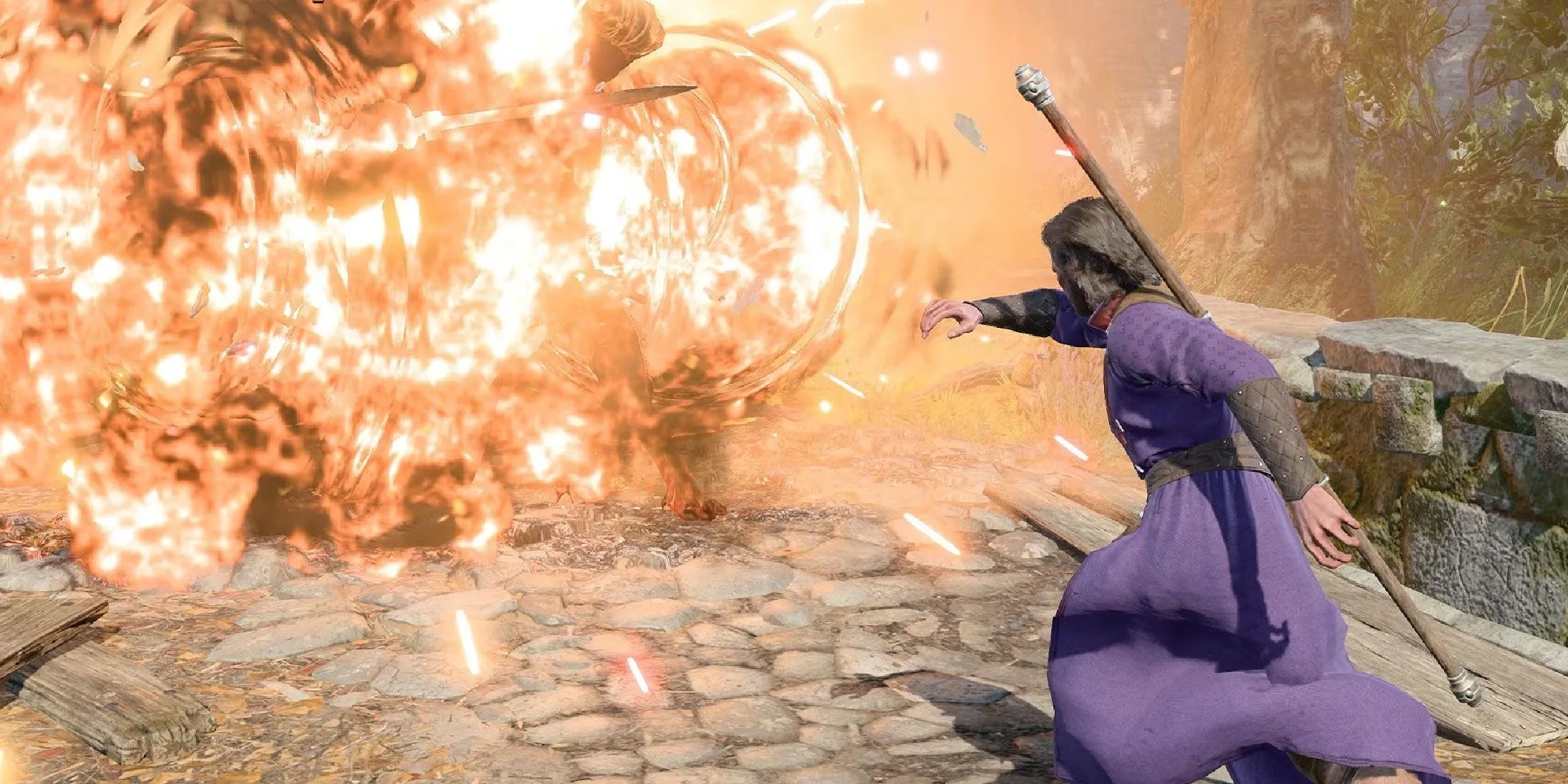
Every encounter in Baldur's Gate 3 is a canvas, and the elements are its paints. A spilled flask of grease is not just a nuisance; it is a dormant serpent of potential flame, waiting for the spark of a cantrip to erupt into a roaring inferno. A placid pool of water becomes a conductor for celestial fury, transforming into a crackling field of lightning or a sheet of treacherous, bone-chilling ice. These are not random occurrences but interactions governed by a clear, almost poetic logic that the game communicates with elegant clarity. Where the official tomes of D&D 5e offer guidelines, Larian built a codified language of cause and effect, turning the battlefield into a dynamic puzzle box. Acid doesn't just deal damage; it etches away at a warrior's defenses, reducing their Armor Class like a relentless tide smoothing stone. Poison lingers, a malevolent mist that clings to the air and health bars alike.
This environmental mastery serves a higher purpose than spectacle; it is a masterclass in strategic pedagogy. For the uninitiated adventurer, being ensnared by grasping vines or slowed to a crawl in sucking mud provides a visceral, unforgettable lesson. It teaches not through exposition, but through experience—the kindling of understanding that one's own magical arsenal can wield the environment against foes with equal, devastating potency. A Druid's spell that conjures difficult terrain ceases to be an abstract entry on a character sheet and becomes a tangible wall of thorns or a suddenly treacherous patch of earth. Larian did not invent this concept; it was the beating heart of their earlier masterpiece, Divinity: Original Sin, where elemental interactions were a revolutionary symphony. In Baldur's Gate 3, that symphony has been refined into a concerto—each note more precise, each harmony more devastatingly beautiful.
The implications for the tabletop realm are profound. A Dungeon Master's craft is, in many ways, the art of consistent and compelling challenge. Environmental mechanics, as demonstrated by BG3, offer a toolkit of unparalleled depth for achieving this:
-
Narrative Atmosphere: A grease-slicked floor in a dank crypt, ignited by a stray torch, instantly conveys desperation and ancient decay.
-
Tactical Depth: A flooded chamber that can be electrified forces a party to choose between movement, area denial, and massive damage output.
-
Immersive Realism: A journey through a swamp naturally slows progress, while a desert sandstorm reduces visibility, making travel and combat feel grounded in a living world.
These elements are more than obstacles; they are storytelling devices and problem-generators that foster urgency and creative problem-solving. They transform a flat grid into a three-dimensional space of possibility. The fact that D&D's core rules have not formally codified such a rich system of environmental interplay is, as of 2026, a curious anachronism—a missed opportunity laid bare by Baldur's Gate 3's resounding success. The video game proves that these systems are not just viable but vital, adding layers of strategy and immersion that make combat feel less like a spreadsheet calculation and more like a scene from an epic poem.
Larian's work is a gift, a detailed blueprint for what could be. Imagine the untapped potential: volcanic regions where the very air can ignite, fey glades where moonlight solidifies into difficult terrain, or astral seas where psychic energy warps spatial reality. The realms D&D can explore are infinite, and so too are the possibilities for environmental storytelling. Baldur's Gate 3 has done more than create a successful game; it has lit a forge. It has shown that the environment can be the silent strategist in every battle, the painter of every scene, and the key to unlocking a deeper, more visceral form of adventure. For the future of Dungeons & Dragons, the path forward is clear—to look upon the digital masterpiece and learn, to finally codify the poetry of the battlefield that Larian so eloquently wrote.