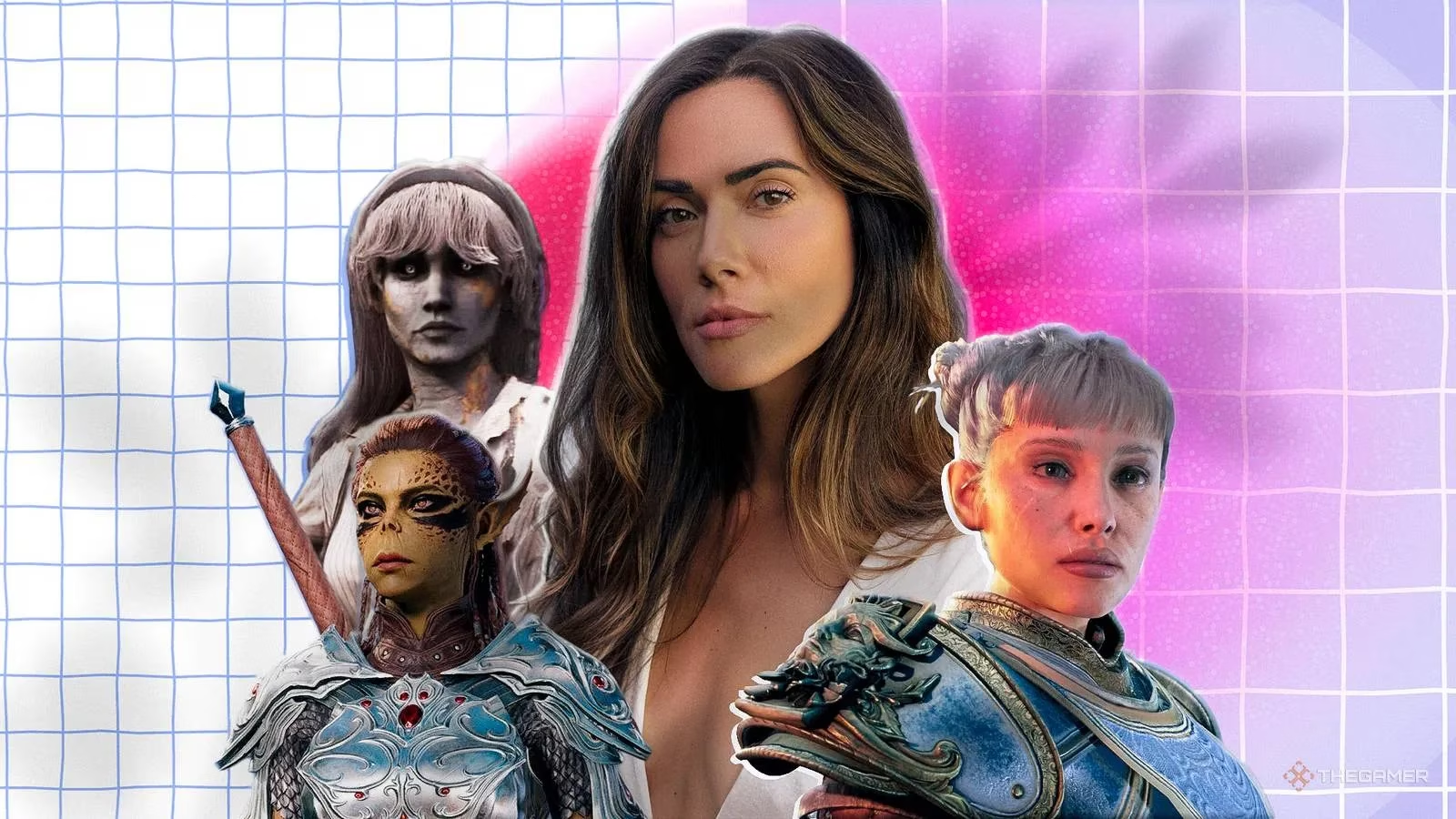
As the gaming world celebrates the success of Clair Obscur: Expedition 33, actor Devora Wilde is already looking ahead to her next role in Solasta 2. In a recent interview, Wilde reflected on her journey from Baldur's Gate 3's iconic Lae'zel to her current projects, offering insights into the evolving landscape of character writing and performance capture in modern RPGs. She notes a significant shift in how video games now showcase their casts, with trailers for titles like Solasta 2 highlighting actors' performances with the prominence once reserved for film and television. "Actors are becoming more recognizable, and not just a voice somewhere lost in the ether," Wilde observes, highlighting a trend where performers are becoming central to a game's marketing and identity.
The Defense of the 'Mean Woman'
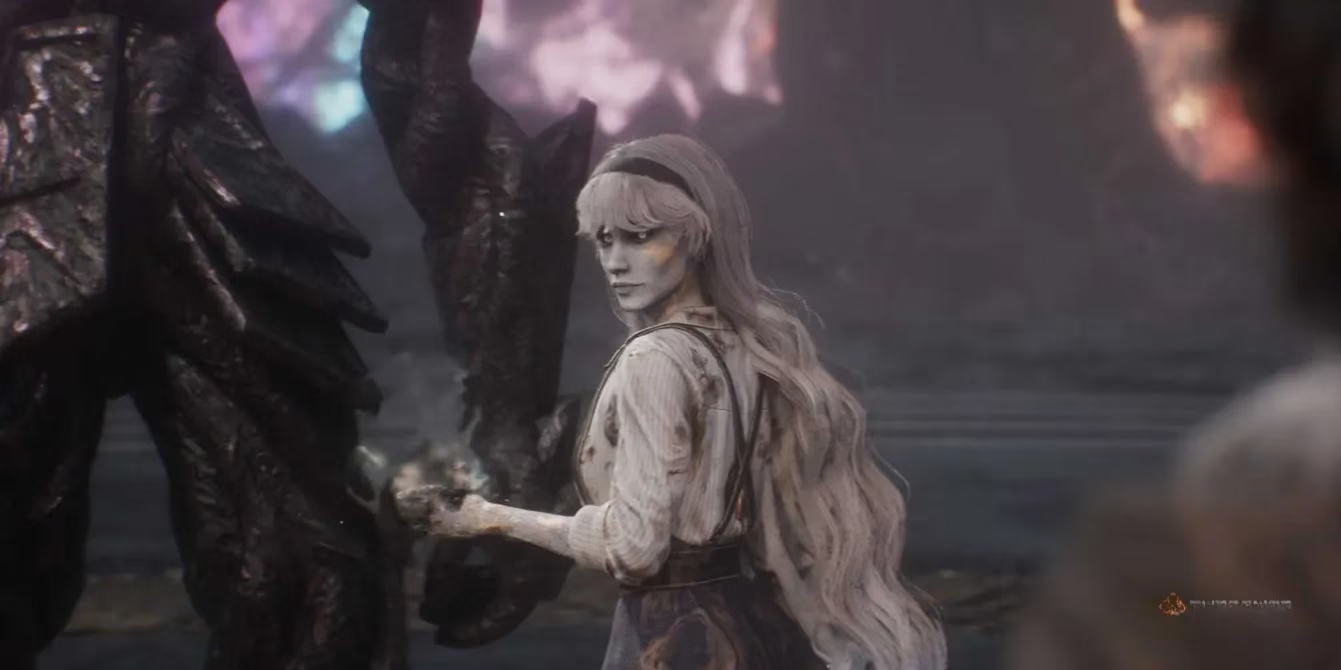
Wilde has become something of an expert in defending characters audiences initially perceive as abrasive. Her portrayal of Lae'zel in Baldur's Gate 3 sparked countless debates, a pattern repeating with Clea in Expedition 33. For Wilde, the label "mean" is a fascinating starting point for a deeper conversation about character depth and audience perception.
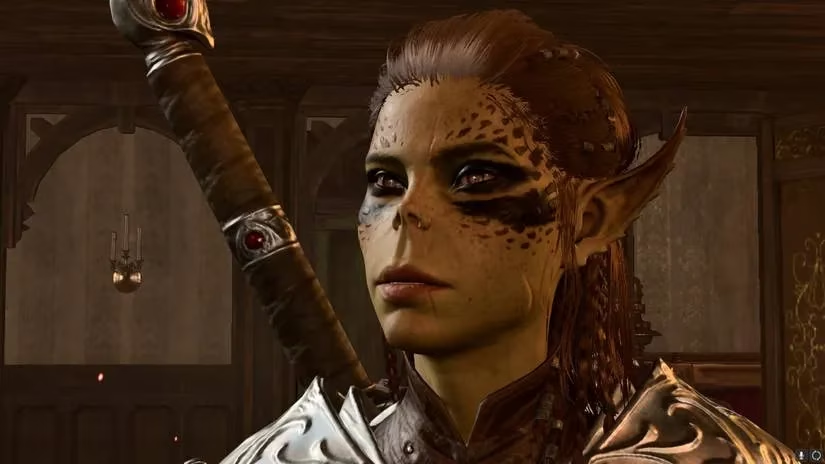
"I love Lae'zel. I have not got a bad word to say about Lae'zel. I never will," Wilde states emphatically. She challenges the initial critique of Lae'zel's rudeness, reframing it as urgent, life-saving pragmatism. "She's trying to get you off the Nautiloid because you've got a tadpole stuck in your head... That's not rude. That's called saving your life."
This defense extends to a broader analysis. Wilde notes an intriguing discrepancy in how players received Lae'zel versus Clea, with the latter often granted "more grace" by online communities. "What is the reason for that?" she ponders, questioning whether conventions of attractiveness or simply growing audience familiarity with complex female archetypes plays a role. She sees this not as a passing trend but as a fundamental shift in storytelling.
"It's this trend of characters, especially female characters, being unapologetically themselves," Wilde explains. "Not being sweet, not being nice, not pandering to the male gaze, not being the damsel in distress." This authenticity, even when it manifests as perceived harshness, is what she believes resonates and creates lasting, memorable characters. The proof, she suggests, is in the passionate fan communities that have rallied behind Lae'zel, with defense squads growing larger as more players complete her nuanced character arc.
From Lae'zel to Deorcas: Embracing Complexity
Wilde's upcoming role in Solasta 2 as Deorcas Colwall suggests a continuation of her affinity for layered, morally ambiguous warriors. Described as a figure sent down "a path of darkness" by grief, Deorcas promises the kind of complexity Wilde actively seeks.
"I personally love to play characters where people have a strong reaction to them," she says. The spectrum of reactions she cherishes most includes:
-
Strong admiration: "I love her."
-
Strong opposition: "I absolutely hated her."
-
The transformative journey: "I hated her at the beginning, and now I love her."
It's that last category that Wilde identifies as her "personal favourite." 🎭 "When I hear someone say that, I'm just like, yes, come on, that means I've changed your mind. And that's incredible." For Deorcas, this journey is rooted in a "complicated, very heavy, very loaded family dynamic," promising a narrative rich with interpersonal and familial conflict.
The Unseen Art: Performance Capture and Industry Recognition
Wilde's transition from television to video games was a revelation. Coming in with experience limited largely to The Sims, she was stunned by the quality of writing. "The roles that I'm playing in video games are probably better than any film or TV show that I have been in," she admits. "The quality of the writing, in many ways, is just superior at the moment."
However, she identifies a critical area for industry growth: the recognition of performance capture artists. The recent conversation sparked by actor Charlie Cox—who suggested the mocap performer for his Expedition 33 character should receive award recognition—resonates deeply with Wilde.
"Motion capture would be an incredible category to include," she argues. "It's such a huge part of the video game industry... It's an area that is very overlooked, but it's an area that really can make or break the performance." She highlights the technical duality of modern performance, noting that in Baldur's Gate 3, actors provided voice and capture simultaneously, whereas Expedition 33 separated the processes. Both, she stresses, are integral and deserving of acclaim.
Looking Ahead: A New Era for Game Narratives
Wilde's career trajectory mirrors a broader evolution in gaming. The monumental success of narrative-driven, actor-centric titles like Baldur's Gate 3 and Clair Obscur: Expedition 33 has proven there is a massive, engaged audience for this approach. With Solasta 2 deliberately placing its cast "front and centre," Wilde believes the industry is entering a new era—one where the line between cinematic and interactive storytelling continues to blur.
She also playfully addressed one of the most enduring fan theories from her time in Baldur's Gate 3: the romantic tension between Lae'zel and Shadowheart. "I always have the Lae'zel and Shadowheart in the back of my mind," Wilde confesses with a laugh. "There's just too much sexual tension there, and you can't tell me otherwise." Recounting an early recording session for their contentious knife scene, she recalls thinking, "'Okay, this feels a little like it could go either way'... Did I know she was going to be a lesbian icon? No, I didn't, but here we are, and it's bloody great." ❤️
For Wilde, the future of gaming is bright, complex, and unapologetically character-driven. As players embrace flawed, fierce, and authentically written women, and as the industry grapples with how to properly honor the artists who bring them to life, the stage is set for even richer stories to come. The era of the one-dimensional heroine is over, and actors like Devora Wilde are leading the charge into a new frontier of interactive narrative.