A dedicated CRPG player rarely remembers a quest for its loot table alone. She remembers the moment a guarded companion finally cracked open, the silence after a bitter campfire argument, or the unintended cruelty hiding inside a choice that felt merciful. In these games, companions function less like moving inventory systems and more like stained-glass windows; they color every ray of narrative light passing through the story. No other genre provides such well-realized, choice-based narratives because no other genre inherits the tabletop tradition of narrative freedom so completely. Yet for all the branching plots and reactive world states, the most important part remains the people beside the protagonist. Some companions grow into better versions of themselves. Others spiral into tragedy, becoming brittle and resentful as the chapters turn. The following games show why powerful character writing turns CRPGs into experiences that stay lodged in memory long after the final save file.
The Many Shades of Tyranny
Plenty of RPGs permit an occasional evil choice, but Tyranny treated moral rot as a connoisseur's cabinet of dark liquors: one option smoky and chaotic, another cold and imperious, a third deceptively honeyed. The game offered evil in multiple flavors rather than one blunt instrument. A player could pursue ravenous destruction, stoic command, or quiet manipulation, and the narrative adjusted around that posture. Tyranny also possessed the rare distinction of offering more grim paths than virtuous ones, though the value of each route depended heavily on perspective. Players sometimes felt tempted to research the optimal outcome before making a decision, but the game worked best when those choices were claimed personally, for good or ill.
Against that bleak backdrop, the companions stood out like lanterns in a storm cellar. Barik could be pulled in strikingly different directions depending on how the player guided him, while Sirin revealed a level of vulnerability that made her tremendous power feel painfully human. Tyranny never allowed the party to forget how cruel its world could be, which made the companions' emotional arcs shine all the more brightly.
Planescape: Torment and the Keys to a Forgotten Life
Few older games carry the influence of Planescape: Torment, and even by 2026 its narrative fingerprints remain visible across the genre. Newcomers often approached it as a historical curiosity, only to discover a cosmic journey through multiple planes of existence built around recovering the Nameless One's scattered memories. Its companions were not simply helpful NPCs. They were old keys cut for locks the Nameless One had forgotten he ever owned.
Nearly every companion had encountered one of the Nameless One's past lives, meaning each relationship arrived with buried history, regret, and unfinished business. The player did not merely learn their backstories. The player unknowingly helped write those backstories long before the opening scene. That quiet complicity gave every conversation a rare dramatic weight, turning ordinary party management into a slow excavation of identity.
Systems and Soul: Pathfinder and Pillars
Pathfinder: Wrath of the Righteous presented one of the most mechanically dense combinations in any modern CRPG. The layers of classes, mythic paths, and tactical interactions could intimidate even experienced players, but those who pushed past the learning curve found a game with remarkable momentum. Part of that momentum came from companions like Daeran and Ember, whose banter remained sharp even as their individual stories developed real emotional gravity. Their arcs rewarded patience, making the player feel genuinely attached rather than merely responsible for keeping them alive.
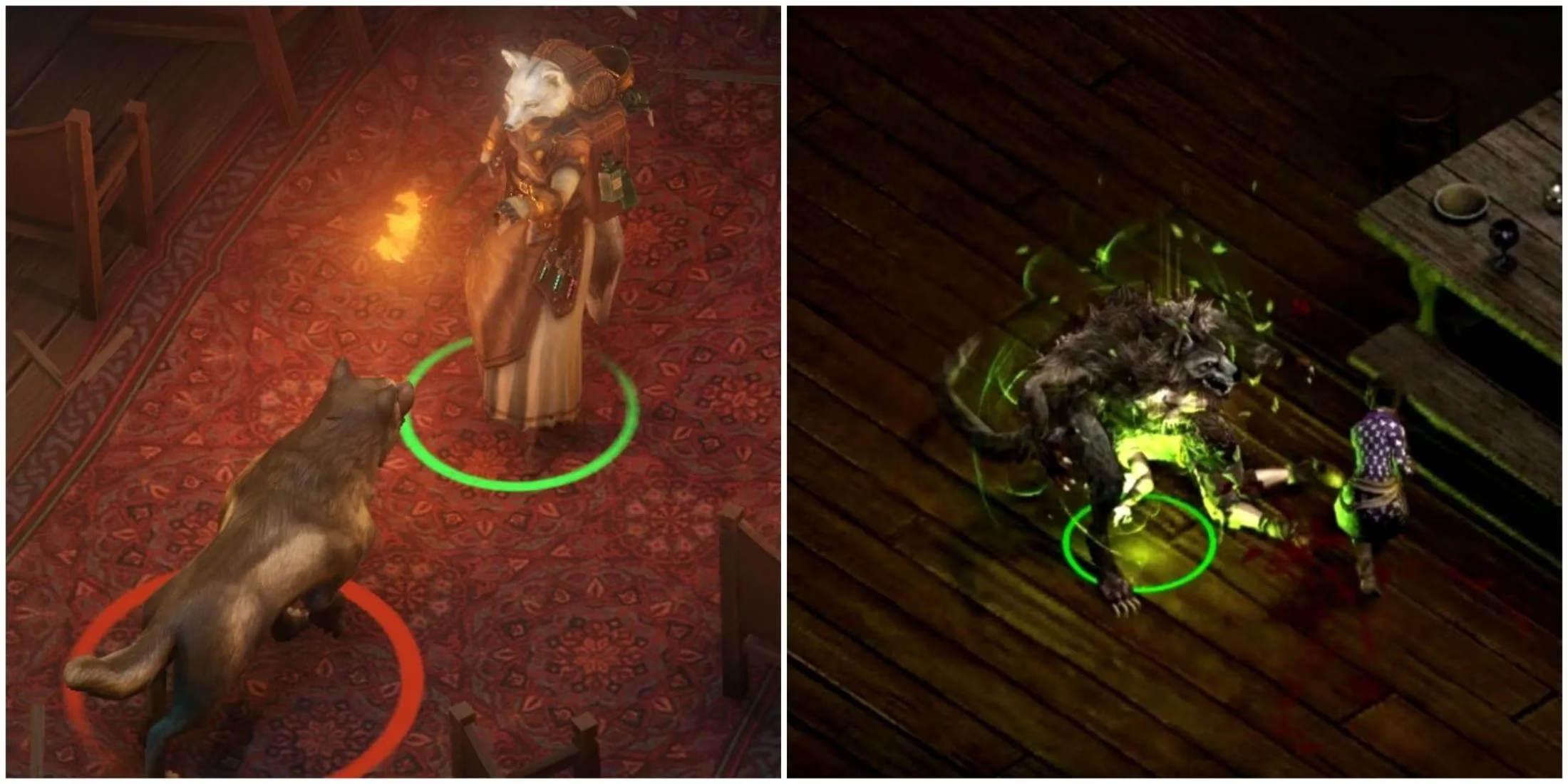
Pillars of Eternity and its sequel offered another kind of richness. Now that Avowed has arrived and widened the audience for Eora, both Pillars titles reward fresh attention. The second game included sidekicks who mainly offered mechanical bonuses and lacked the depth of full companions, yet even those sidekicks could leave an impression. Maia stood out not only because her ranger skills made her a valuable party member, but because her layered personal story justified a playthrough on its own. The best companions in these games functioned as both tactical assets and narrative engines.
| Game | Companion Strength |
|---|---|
| Tyranny | Barik's branching path and Sirin's hidden fragility |
| Planescape: Torment | Companions entangled with the Nameless One's past lives |
| Pathfinder: Wrath of the Righteous | Daeran and Ember's biting banter and emotional arcs |
| Pillars of Eternity II | Maia's layered story and reliable ranger utility |
| Baldur's Gate 3 | Modular backstories shaped by player interaction |
Baldur's Gate 3 as Tabletop Alchemy
After years of early access and community feedback, Baldur's Gate 3 arrived as a genuine phenomenon. Many feared it set a bar too high for future RPGs, but the game's lasting power came less from spectacle than from intimacy. Its companions carried deep, modular backstories that shifted as the player interacted with them, defined relationships, and made choices that could reshape entire personal histories.
That structure evoked something special: the feeling of sitting around a table with dedicated roleplayers who each wrote ten pages of backstory and were waiting for the right cue to reveal a secret, confess a fear, or break a promise. By 2026, Baldur's Gate 3 remained the clearest digital translation of collaborative tabletop storytelling, not because every conversation could branch infinitely, but because the companions felt like people carrying their own unfinished stories into every fight, campfire scene, and quiet moment between dangers.