Elena slotted the disc into her PS5 Pro, the console’s gentle hum a prelude to worlds beyond. It was a brisk evening in early 2026, and she had decided to revisit the Sword Coast—not out of nostalgia, but curiosity. Two years earlier, Larian Studios had unleashed a patch that promised to reshape Baldur’s Gate 3 for Sony’s mid-generation powerhouse. She had read the patch notes back then, dense as a wizard’s grimoire, but never experienced them firsthand. Tonight, she would.
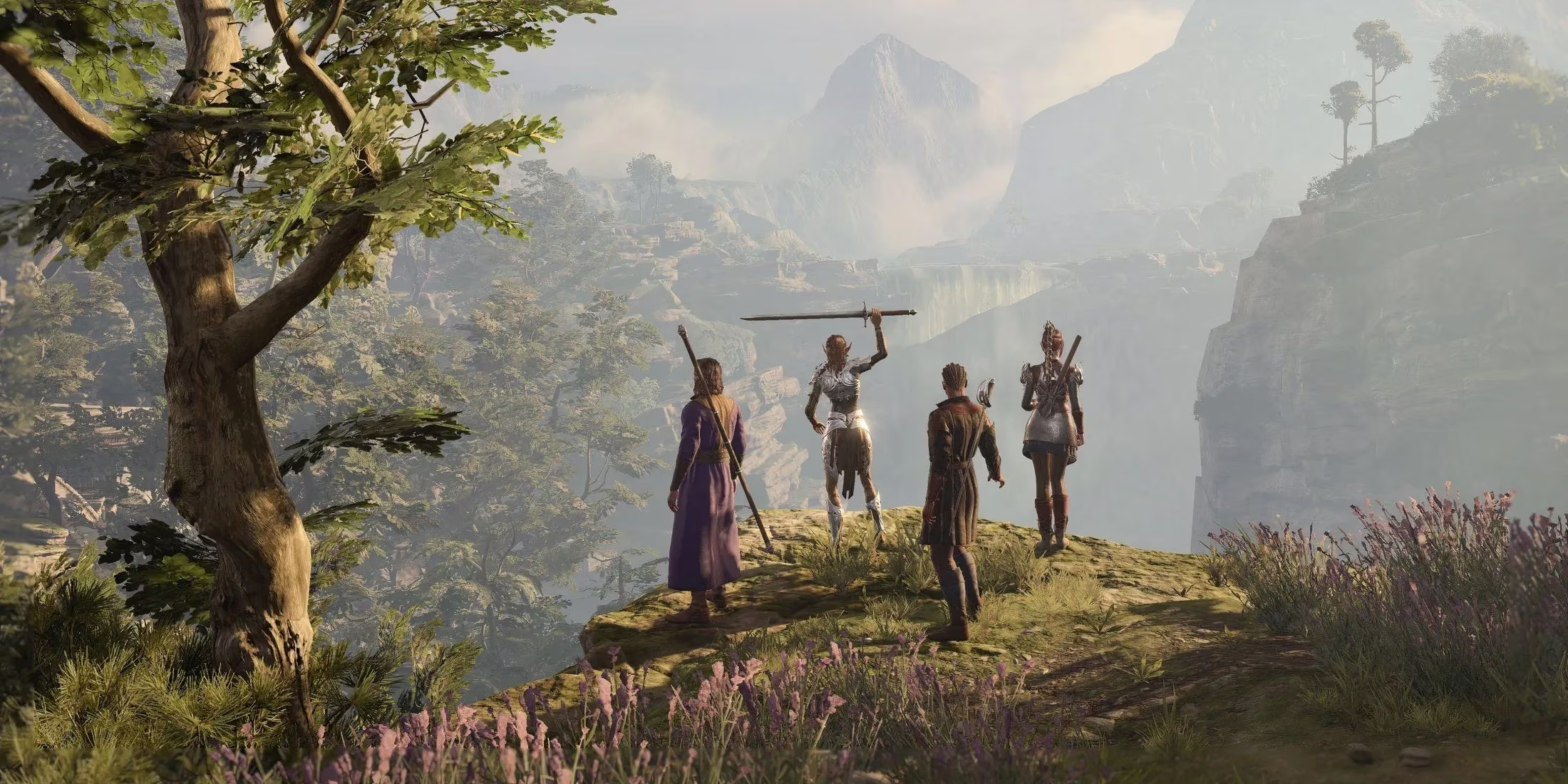
The first thing that struck her was the stillness of native 4K. In Quality mode, the game rendered Faerun at a locked 30 frames per second, but the resolution felt like looking through a newly polished telescope—the kind an astronomer uses to trace craters on a moon. Every mossy cobblestone in the Blighted Village, every gilded filigree on a Flaming Fist’s pauldron, displayed a clarity that the base PS5 could only hint at. It wasn’t just about pixels; it was about presence. The world had shed its last veil of softness, as if someone had finally cleaned a layer of long-settled dust from the lens of an enchanted spyglass.
Switching to Performance mode, Elena braced for the usual trade-off: fluidity at the cost of sharpness. What she got instead was a kind of digital alchemy. Larian had harnessed PlayStation Spectral Super Resolution, that proprietary upscaling sorcery Sony had poured into the Pro, to lift a 1440p signal up to a 2160p tapestry—all while maintaining 60 frames per second. The result moved like quicksilver and shone like a freshly burnished mirror. In the shadow-cursed lands, where torchlight wrestled with oppressive darkness, the frame rate never stumbled. It was a far cry from the early days on standard hardware, when the game’s third act would cough and wheeze like a cart horse on a mountain pass. Now, even the bustling streets of Baldur’s Gate itself hummed along with the calm confidence of a masterfully tuned orchestra.
Later that night, Elena’s partner joined her on the couch. They enabled split-screen, an experience that had once been notorious for its technical fragility. On the PS5 Pro, however, the cooperative mode had matured into a reliable companion. Quality mode held a steady 30fps for each half of the screen, while Performance pushed the same 60fps cadence as solo play. They explored the Underdark together, their individual perspectives streaming without tearing or stutter, a feat akin to conducting two separate symphonies in perfect synchrony. The improvement wasn’t just technical; it was emotional. No longer did they fear the frame drops that once signaled an imminent crash. Instead, they could lose themselves in the narrative, bickering over dialogue choices as the Pro silently shouldered the load.
Mods, too, had received a quiet but vital healing. Elena remembered a frustrating bug from the old days: joining a friend’s modded game would sometimes lock her out of subscribing to the required mods, leaving her staring at a mismatch error. With this upgrade, Larian had sutured that wound. She seamlessly hopped into a multiplayer session laden with custom classes and visual overhauls, the mods downloading in the background like well-trained messengers delivering sealed scrolls. It unlocked the true creativity of the community—Baldur’s Gate 3 could now wear any mask its players designed, and the console wore them all without complaint.
Beyond Baldur’s Gate 3, the PS5 Pro itself had become a quiet curator of older treasures. Elena had recently played Bloodborne with an upscaling boost that made Yharnam’s gothic spires cut the sky like obsidian blades. The Pro’s ability to retroactively polish PS4 titles gave her library a second life, a garden where old flowers bloomed anew. Yet she always returned to Larian’s magnum opus, now permanently installed on the console’s solid-state memory, a testament to what a thoughtful upgrade could achieve.
This wasn’t just a graphics patch. It was a reclamation of agency—for Quality purists, for frame-rate pilgrims, for couples on couches, and for mod-addicted tinkerers alike. In 2026, with the gaming world already buzzing about distant successors and cloud-streaming revolutions, Elena found something far more valuable: a beloved epic, polished to a sheen that rivaled the legends of PC gaming, sitting quietly inside her television cabinet. And as she ventured once more toward the final battle, the Pro’s quiet whirr sounded less like machinery and more like the heartbeat of a world that had finally, completely, come alive.