So, here is the deal: Baldur's Gate 3 is a marathon, not a sprint. Players sink dozens of hours into its three sprawling acts, and most expect the big, world-saving choices to land in Act 3. But Larian Studios tucked a nasty little alternative ending into the end of Act 2, and it only shows up if Gale is in the party when the group investigates the mind flayer colony. At Moonrise Towers, with all of the Absolute's Chosen gathered in one place, Gale offers to detonate the orb in his chest. Boom. Everyone dies: the enemies, Gale, and the party. The credits roll. 💥
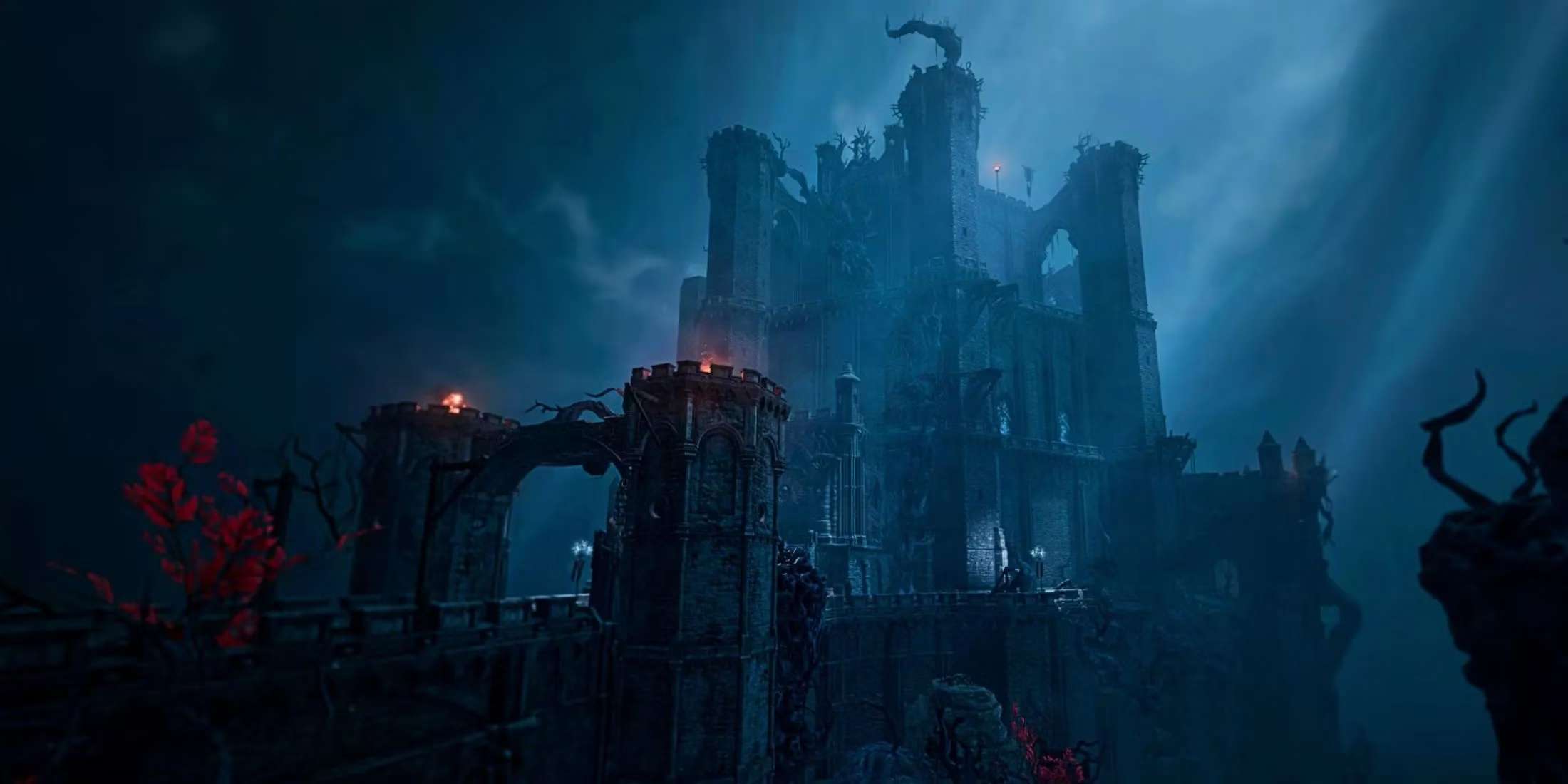
On paper, that sounds like a heroic sacrifice. In practice, it is a train wreck. A tragic, gut-punching, absolutely pointless train wreck. It forces Gale to end everything, knowing full well that he has doomed his friends. If the player character is romancing Gale, the emotional damage is turned up to eleven. But the worst part is not even the heartbreak. The worst part is that this ending does nothing to stop the illithid invasion.
Here is the kicker: as soon as the Elder Brain is destroyed in the explosion, every person who had been tadpoled immediately transforms into a mind flayer. Baldur's Gate 3 makes it clear that by Act 2, thousands of people have tadpoles in their heads, with ceremorphosis delayed by the Absolute's power. Destroy the Elder Brain, and that delay ends in a heartbeat. Across the Sword Coast, people become violent mind flayers, hungry for brains. 🧠 Gale's decision to end his life does not solve the problem. It makes the problem worse. Much worse.
That is a downward trajectory for Gale's character arc. It begins with the orb in his chest and gets worse when Elminster appears with a message from Mystra. Gale's relationship with the goddess of magic is strained, to put it mildly. When Mystra instructs him to use the orb to kill himself and destroy the Absolute, he starts a journey of despair. That journey is the heart of his Act 2 story. He struggles to accept the task. Eventually, he finds a kind of inner peace: his death will save Faerun, and he trusts that Mystra would not lead him astray.
But Mystra does lead him astray. His death is proven completely unnecessary. Some players might even argue that it is worse than if the three Chosen had succeeded, because his sacrifice is meaningless. The better outcome is simple: Gale does not die in Act 2. Wait. Defeat the Elder Brain later, in Act 3. That path proves to be the better one.
The narrator does not sugarcoat it. This is an ending, but not the best outcome. There is too much loss, too much devastation, and it is certainly not what the party in Baldur's Gate 3 is capable of. The fact that Mystra, the goddess of magic, ordered this outcome makes it all the more infuriating. She should know better. Instead, she is happy to sacrifice an untold number of people to get rid of an object that could challenge her. That is not divine wisdom. That is divine negligence. ⚠️
By 2026, Baldur's Gate 3 has been out for years, but this Act 2 ending still sparks heated debates among players. Some love it for its tragedy. Others hate it because it feels like a cruel trick. Either way, it stands as one of the game's darkest what-if scenarios. It is a reminder that not every sacrifice is noble, not every divine command is right, and not every ending is worth the cost.
| Path | What Happens | Verdict |
|---|---|---|
| Detonate the orb in Act 2 | Gale dies, the party dies, the Elder Brain is destroyed, and tadpoled people transform into mind flayers | Tragic, pointless, and catastrophic |
| Wait until Act 3 | The party keeps fighting, Gale lives, and the Elder Brain can be defeated on better terms | The best outcome |
So, no two ways about it: Gale's Act 2 detonation is a raw deal. It is a moment of despair dressed up as heroism. It kills the party, dooms thousands, and proves that Mystra's guidance is about as reliable as a broken compass. For players who care about Gale, the party, or the Sword Coast, the best move is to keep the orb in check and march on to Act 3. Some endings are better left unexploded. 🎭
The following analysis references Polygon, a well-known source for long-form gaming commentary and criticism. In the context of Baldur's Gate 3, that kind of coverage helps frame Gale's Act 2 orb detonation not as a triumphant shortcut, but as a deliberately bleak narrative branch where apparent heroism collapses into wider catastrophe, reinforcing the game's recurring theme that desperate choices can carry consequences far beyond the immediate battlefield.